

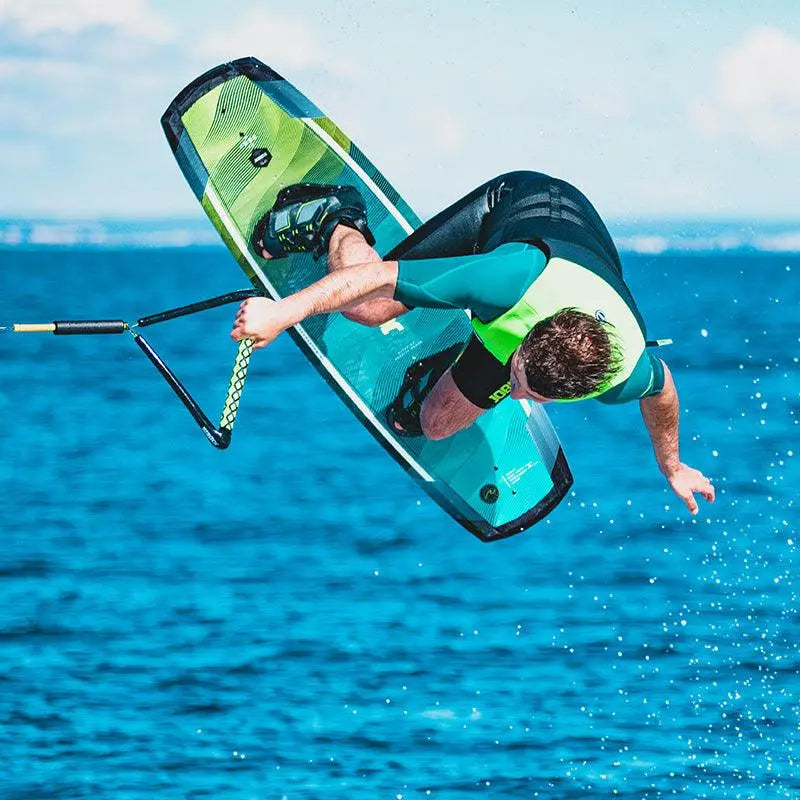
What size wakeboard do I need? Check out the Wakeboard Size Chart.

Most wakeboards are available in different sizes. Unlike most other board sports where your height determines the length of board, the size of wakeboard you choose should be based mostly on your weight. It makes sense as it’s your weight that determines how deep your board sits in the water. Have a look at the size chart below. It gives you an idea of how your weight affects the size of board you should ride.

Remember that each wakeboard is different and has a unique manufacturer’s size chart for that specific board. Check the size chart on the product page of the board you’re looking at for more accurate sizing.
Your riding style
Besides your weight, you should also take your riding style into account. Some people prefer to ride a shorter wakeboard, and some prefer to ride a longer wakeboard.
Choosing for a longer wakeboards
A longer wakeboard is easier to ride and will make for softer landings because of the increased surface area. Also, it will give you more control because of the larger surface area. However, because longer boards are heavier, you have to work harder with air tricks.
The pros of a longer wakeboard
1. Softer landings
Bigger sizes softens up the landings. This makes landings softer and easier on the knees. So if you like to go big off kickers but have knees which can’t handle the impact, a big size is the way to go!
2. Better floating capabilities
Something you also see in the snowboard scene, a big size means lots of floating capabilities! And by having better floating capabilities, riding on the water takes less of your energy and results in an easy and smooth ride.
3. Better flex pattern
The good thing about riding a longer board is that you have more surface area, also next to your binding! Which gives you more surface area to press on and get the max out of the flex pattern of your board.
The cons of a longer wakeboard
1. Slower edge-to-edge
We said it multiple time: more surface area! This also comes with a downfall.. Meaning you have a bigger board which has a slower response when you want to go from you toeside to your heelside.
2. Harder to flip and spin
It’s more surface and thus more weight, what did you expect?! The extra weight you get due to choosing a bigger board makes it harder to flip and spin a board. A big board is fun but there’s a subtle art in overdoing it. So don’t choose a big board which is impossible for you to flip.
3. Harder for inverts
Not only does a bigger board weigh more, the large surface area also tends to "stick" more to the water. We’re not saying that inverts are impossible (far from), you’ll just feel that it takes up more strength and energy to bust out an invert.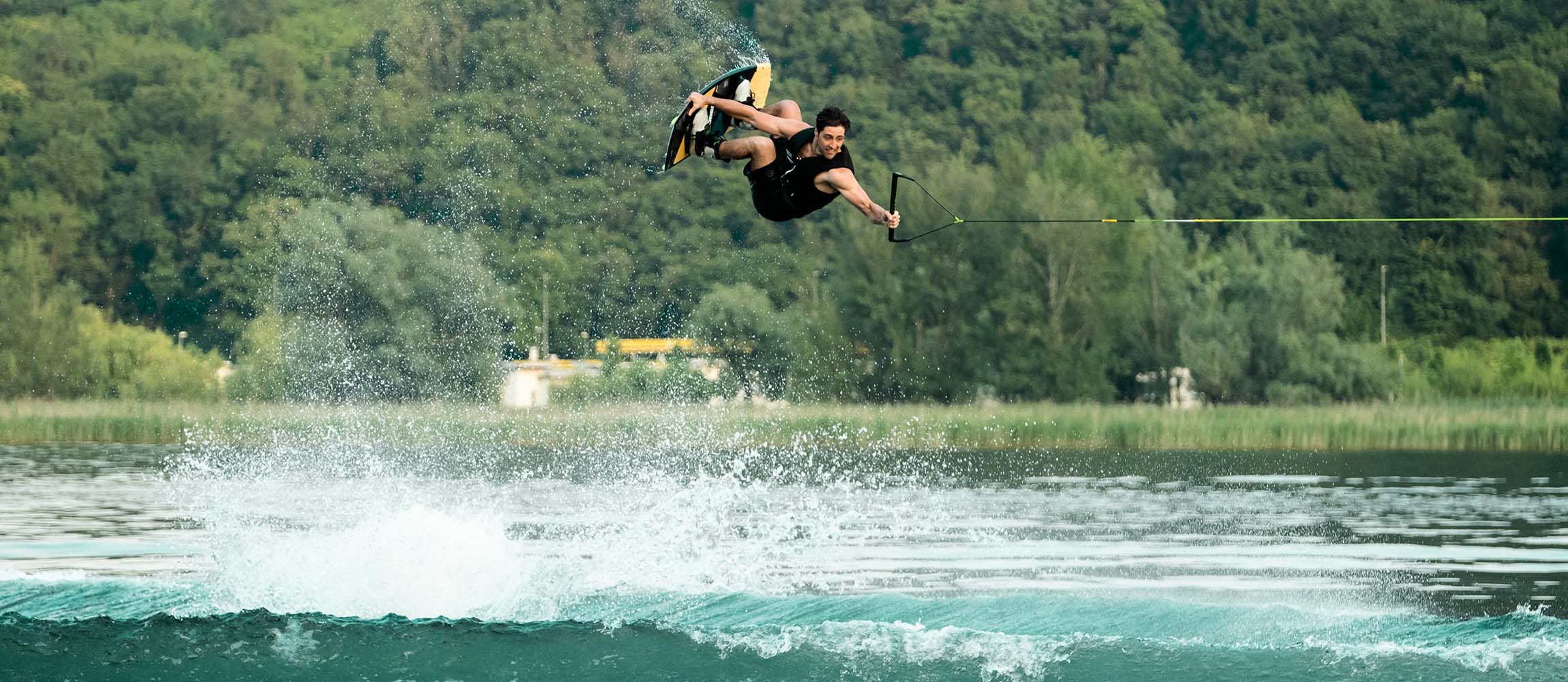
Choosing for a shorter wakeboard
In general, shorter boards are slower and take more effort to push through the water. This is because, the more surface area the board has on the water, the faster it will move across the surface. Also, landings are a bit harder on a shorter board, than on a longer board. On the other side, with a shorter wakeboard it’s easier to do spins and air tricks.
Smaller board are good for invert riding and behind the boat. This is because this kind of riding requires you being in the air a lot. A lot of jumps of the wake and invert riding takes up a lot of strength and a smaller board is better to ride for this kind of use.
The pros of a shorter wakeboard
1. Better for inverts and more air time
Less weight means more airtime, plain and simple as that! A brick will fall down heavier than a feather. Same goes for big vs smaller board, the smaller board will grant you a little bit of extra airtime when sending it of the wake or kickers. You’ll also find that smaller boards are better for inverts, there’s a reason why old school riders all used 137/138 boards all the time.
2. Fast edge to edge
A smaller board is also less wide, which means faster and better edge-to-edge control. You have less surface to put pressure on which makes is faster to switch from edge-to-edge.
3. Faster to spin and flip
Less weight on your feet means it’s much easier to flip and spin the board whenever you feel like it. At the end off the day, no one likes to flip with a heavy brick on their feet.
4. Fast on the water when edging
When you’re riding a smaller size board, you have a smaller effective edge. This basically means that the part of your board which is still in the water is smaller and therefore has less drag on its edge. Less drag equals more speed! So if you need a board that’s fast when you lock your knees and edge hard, a smaller board will give you so much speed, you’ll break sound barriers!
The cons of a smaller wakeboard
1. Tougher landings
Due to having less surface area, there’s less surface to absorb the blow of a hard landing. Don’t get us wrong, you don’t need knees of steel but if you have weak knees, this is something to keep in mind.
2. Costs more energy to ride
Riding a wakeboard in a smaller size means your board has less floating capabilities. Which results in a ride which takes up a bit more of your energy as well.
Conclusion
Big or small, a choice that is always personal. When you look at the size chart of a board you usually have a wide spectrum of sizes you can choose from. But when you have trouble choosing a size, remember to look at the size chart and always ask yourself the question: What do I want to do with this board?
Are you an old school rider who loves to just send it and spend more time in the air? Whether it’s sending it of the wake behind your boat or just busting out raileys all day at the Cablepark, a smaller size would be the way to go.
Or are you the kind of rider that leaves no obstacle untouched in the parks? When you’re out in the park and want to spend full days on the water and need to save energy (or knees), a big board is the solution for those endless day on the water!

Comments
Simon Jarochowicz said:
This is a very well written and informative article, there certainly are more variables to selecting a board length than simply body weight. Thanks for the info!